To begin with
The National Lottery, explained in two minutes
The National Lottery is the game with the longest history at Loterías y Apuestas del Estado: the first draw was held on 4 March 1812 and it has been held ever since. It is also the simplest of all: you do not choose combinations or predictions, you buy a five-digit number, from 00000 to 99999, already printed on a ticket, and on the day of the draw you check whether it has come up.
The décimo, or ticket, takes its name from being one tenth of a billete, or sheet: each number is printed on sheets of ten tickets, and each number comes in several series (six in the Thursday draw, ten in the Saturday draw). That is why the tickets for any given number are limited, 60 on Thursday and 100 on Saturday, and if you have a favourite number it is worth buying it in good time.
Prizes do not depend on a jackpot or on how many people win: they are fixed in advance in the prize schedule that SELAE approves for each draw. The winning number comes out of the drums, one for each digit, and you win if your number comes up in full (first or second prize, or one of the four-, three- and two-digit draws), if it is the number just before or after the first or second prize (near-number prizes), if it shares the hundred or the ending with the first prize, or if it ends in the refund digit. And the refund prize has three chances in every draw: the last digit of the first prize and the two special one-digit draws shown as “R” in the results.
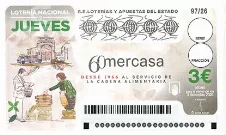
If you want to know what each item printed on a ticket means (number, series, fraction, stamp, barcode), you will find it in the National Lottery ticket, explained.